
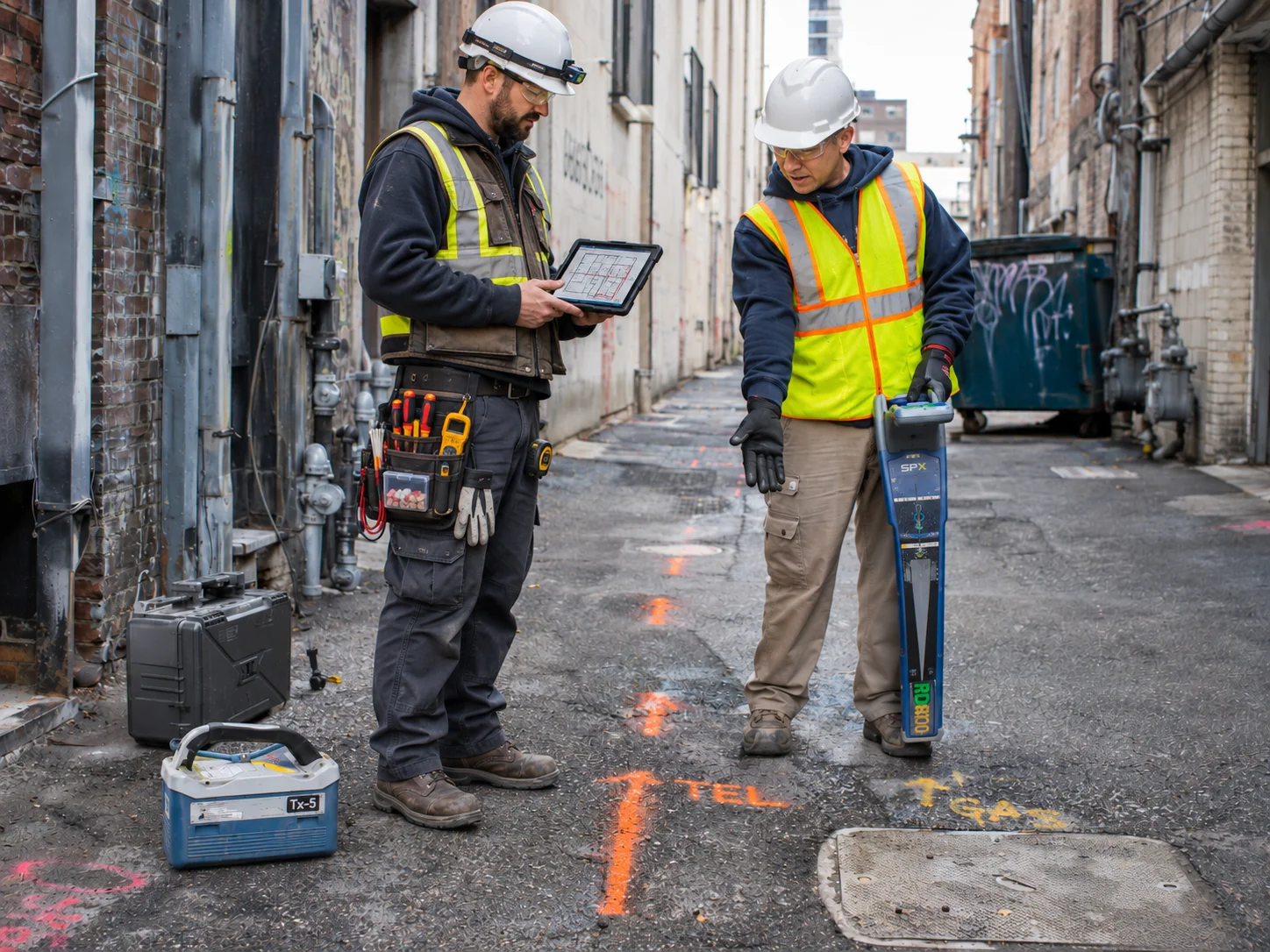
Most electricians don’t think of themselves as diggers. But between trenching submains, running EV charger cables and cutting into slabs, a lot of electrical work happens underground or inside concrete. That’s right where gas, water, NBN and other cables live.
That’s where utility locating comes in. A locate shows you what’s under the surface before you start, so you can dig and cut without guessing.
Electricians are some of our most regular customers at Elite Pipe & Cable. We do pipe and cable locating for electrical contractors across Wollongong, the Illawarra and Sydney. This guide covers what we’ve learnt on the job: when you need a locate, who’s responsible, and how to get the most out of it.
Why BYDA plans aren’t the full picture
Before You Dig Australia (BYDA) is always your first step, and it’s free. However, BYDA plans only show the approximate location of services, so they shouldn’t be used as an exact guide for digging.
They’re indicative. Plans show roughly where an asset should be. Cables and pipes get moved, ground levels change, and old records aren’t always right.
They usually stop at the boundary. Ausgrid, Endeavour Energy and other asset owners map their own networks. The private side of the property is mostly blank.
Private services are exactly what sparkies hit. Consumer mains from the pit to the meter box, old submains to a shed, pool and garden lighting circuits, irrigation lines, stormwater and sewer connections. None of these will show up on a BYDA plan.
A locate fills that gap. It tells you what’s actually in the ground on the day, where it runs, and roughly how deep it is.
Jobs where electricians should book a locate
If the job involves a shovel, an excavator, a saw or a core drill, it’s worth a locate.
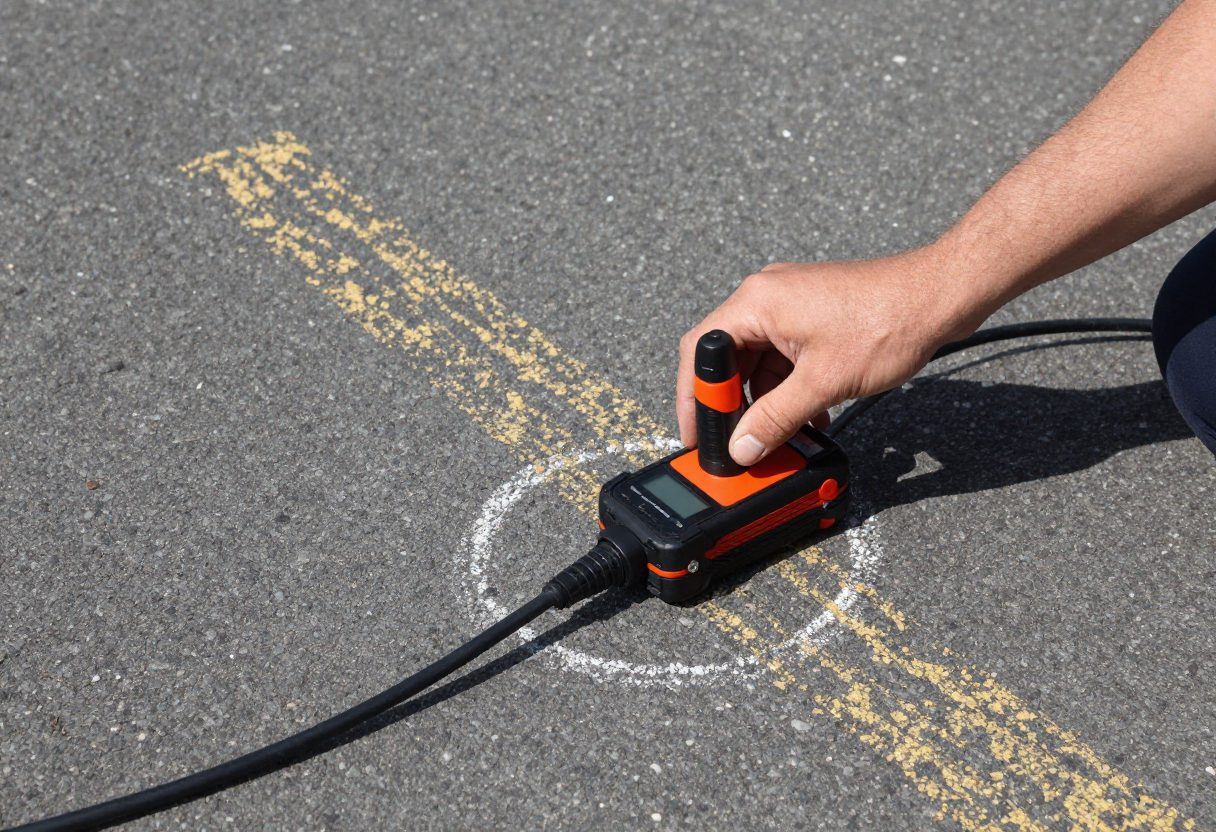
For cable locating, we use Electromagnetic Field Technology. A transmitter puts a signal onto a metallic cable or pipe, and a handheld receiver follows that signal above ground to trace the service’s route and estimate its depth. The receiver can also pick up the signal already running through live power cables.
Many electricians own DIY locating equipment such as a basic cable avoidance tool, but the results depend on who’s using it. Readings can be thrown off by nearby services, shared trenches and poor signal, and it takes training to tell one cable from another. As CERTloc certified locators, we are trained and assessed in identifying and marking buried utilities accurately. Where electromagnetic locating isn’t enough, such as for plastic pipes or services inside concrete, we combine it with ground penetrating radar (GPR) and other equipment, so you get the full picture before you dig or cut.
These are the jobs we get called out for most:
New or upgraded underground supply
When a home or business switches from overhead to underground supply, or gets a bigger service for an upgrade, someone has to trench consumer mains from the street pit to the meter box. That could be a Level 2 ASP doing the network connection, or an electrician running the mains on the property side. Either way, the trench goes through the front yard and often the footpath, which is usually the busiest strip of ground on the whole block.
Submains to granny flats, sheds and garages
Granny flats and backyard studios are one of the most common jobs for electricians in Sydney and the Illawarra. Getting power out there usually means a long trench from the main switchboard across an established backyard, sometimes under paths or driveways. Older backyards are often full of services that were never drawn on any plan.
EV charger installs
EV chargers are a fast-growing job, and they often end up in tricky spots. At a house, the cable might need to cross a driveway or lawn to reach a carport. In strata buildings and commercial car parks, it often means saw-cutting or core drilling slabs to run conduit back to a distribution board.
Outdoor lighting, gate motors and poles
Garden and path lighting, driveway gate motors, bollards, and footings for light poles, CCTV poles or signage all need cables in the ground. Pole footings go deep, and they’re often dug with an auger, which gives you no warning when it hits something.
Solar and battery jobs
Most solar goes on the roof, but ground-mounted arrays, and batteries or inverters installed away from the house, need underground cable runs. On larger blocks and rural properties, those runs can be long.
Renos and knockdown-rebuilds
Older properties often have cables and pipes that nobody remembers. Some are long dead. Others are still live and feeding a shed or pump nobody mentioned. Before demolition or new trenching, you want to know what’s there and which is which.
Extending or repairing an existing circuit
Sometimes you need to know exactly where a cable you didn’t install actually runs. Adding a circuit to an outbuilding, moving a cable out of the way of an extension, or digging up a damaged run all start with finding the route. There’s more on this in the next section.
Commercial and civil sites
Schools, car parks, council sites, shopping centres and industrial sites are crowded underground, with services added over decades. Head contractors often won’t let any trade dig without a locate on file, and many need a report for the site’s safety records.
It’s not just about compliance: finding your own cables and conduits
BYDA and safety are big reasons to book a locate, but they’re not the only ones. A lot of electricians book us simply because they need to find something. Common reasons include:
Tracing a cable from the switchboard. We can follow a specific cable from a known point, like the switchboard or a pit, and mark its full route and depth. Handy when you need to tap into it, reroute it or work around it.
Finding where a conduit runs. Before you cut into a conduit, you need to know where it goes and what else might be inside it.
Sorting out old and redundant cables. Find out what’s still in the ground before you start a new run, so you’re not guessing what’s live and what’s been abandoned.
Checking depth. Know how deep an existing cable sits before you dig near it or run a new cable alongside it.
Saving time on repairs. Knowing the exact route means you dig in the right spot, instead of trenching the whole run looking for a damaged cable.
This matters more than it sounds. SafeWork NSW issued a safety alert after an electrical contractor was fatally shocked while cutting into an underground conduit. He was replacing a lighting circuit, but the same conduit also carried a live 415 volt three-phase submain. The alert points to two failures: not identifying everything inside the conduit, and not isolating power at the main switch.
Cutting or coring concrete? Scan it first
It’s not just trenches. Saw-cutting a slab to run conduit, or core drilling for a new penetration, is one of the riskiest jobs on an electrician’s list. You can’t see what’s inside the concrete, and a lot of it is live.
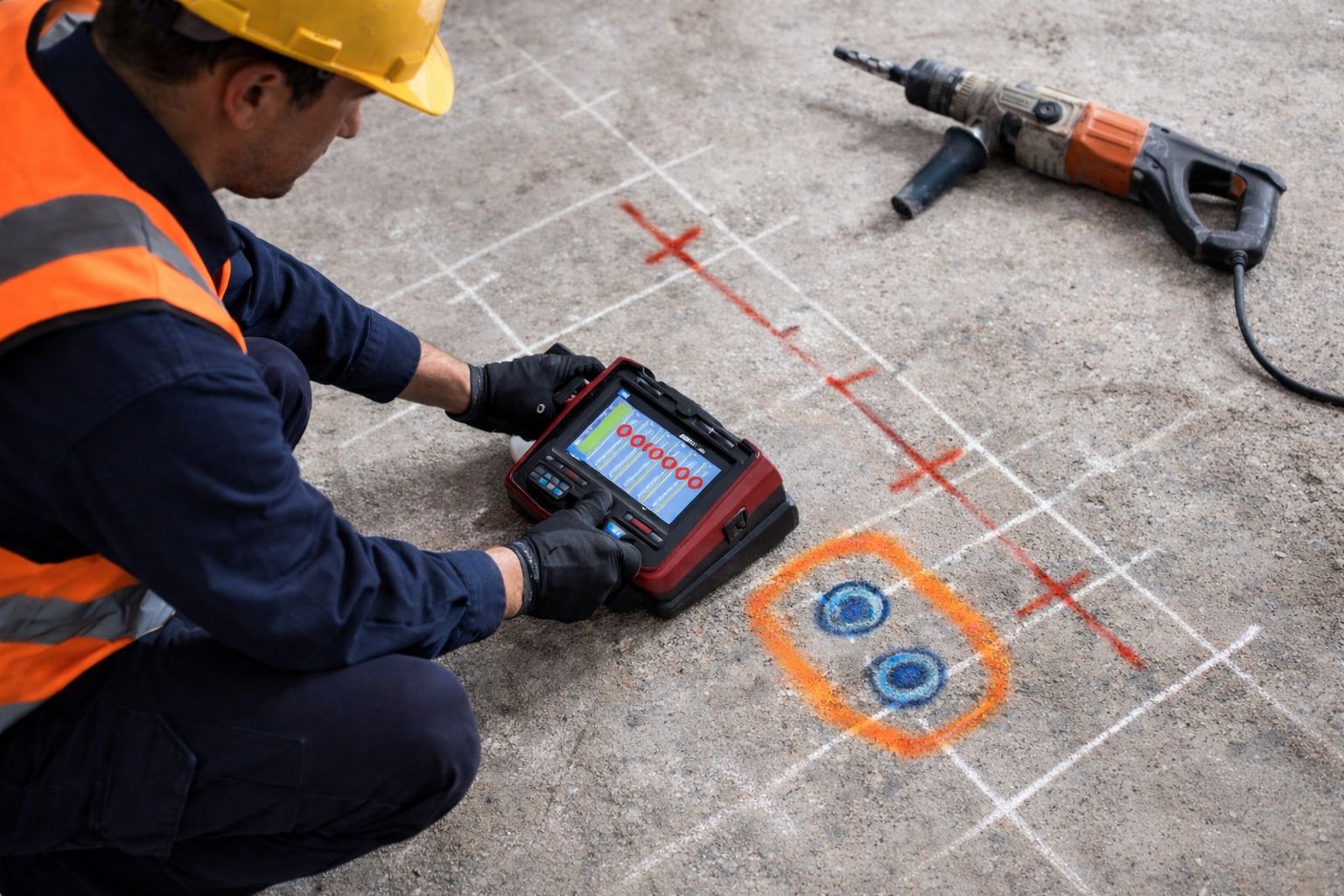
We use ground penetrating radar (GPR) for concrete scanning before you cut. It picks up:
- Existing conduits and the cables inside them
- Steel reinforcement (rebar and mesh)
- Post-tension cables, which you really don’t want to cut
- Plastic water and drainage pipes that a standard cable locator can’t detect
We often scan around existing conduits so you know exactly where the cable sits before you cut nearby. It’s a quick job that saves a lot of headaches, from a tripped board to a damaged building.
Who is responsible for locating underground services?
Responsibility generally sits with the business carrying out the excavation or cutting work. If your team is digging the trench or cutting the slab, the duty to locate services applies to you.
Under NSW Work Health and Safety rules, the business carrying out excavation work must obtain information about underground services before work begins. On construction sites, the builder or principal contractor also has obligations, and all parties are expected to consult and coordinate with each other. A locate arranged by the builder for another area of the site does not cover a new trench or cut elsewhere.
On most residential jobs, the homeowner does not carry the WHS duty. It rests with the contractor performing the work. A quote or contract can set out who pays for the locate, but it cannot transfer the safety obligation to the client.
A locate report on file provides a clear record that underground services were identified before work started, and helps demonstrate that your WHS obligations have been met.
What happens on a locate
No big drama. Here’s how a typical job runs:
- You lodge a BYDA request and send us the plans when they come back.
- You book us in with the address, the job type and your planned trench route or cut area.
- We scan the site using electromagnetic locators for metal pipes and cables, and GPR for plastic pipes and concrete. Every locate covers all the services that could be in the way, not just the electrical ones. Gas, water and NBN are just as easy to hit with a trench.
- We mark it out on the ground with paint or flags, so you and your crew can see exactly where everything runs.
- You get a report with photos and notes, ready for your job file or the builder.
Then you dig with confidence instead of crossing your fingers.
Tips to get the most out of your locate
- Book early. BYDA plans can take a couple of business days, so get the request in when you win the job, not the morning you start.
- Mark your trench route. A quick line of white paint or a sketch on the plan shows us exactly where you want to dig, so we scan the right area.
- Tell us how deep you’re going. Consumer mains, submains and conduit runs all sit at different depths, and it helps us focus.
- Pothole before you bring in the machine. A locate tells you where services are. Hand digging or vac excavation lets you see them before the excavator gets close.
- Keep the marks. Don’t let the landscaper or concreter wash them away before you’re finished. If they disappear, give us a call.
- Build the cost into your quote. A locate costs far less than a single strike, and most clients appreciate a tradie who does things properly.
Locating for electricians across Wollongong and Sydney
Electricians are among our most regular customers. Based in the Illawarra, we work with electrical contractors across Wollongong, Shellharbour and the South Coast, as well as throughout greater Sydney.
We provide utility locating in Sydney and the Illawarra, most often in Wollongong. Jobs range from EV charger installs in strata car parks to submains for suburban granny flats, and on new builds and renovations we often work alongside the builder too.
Many electricians simply save our number and send through the address when a job comes up. You can expect a prompt response, clear markings on site and a report ready for your job file.